
History of the farm
Gwyddgrug: a village rooted in history
Gwyddgrug is a small village in Carmarthenshire, West Wales, located on the Roman road ‘Sarn Helen’ (now the A485) approximately 1½ miles east of Pencader.
The village's name (historically alternatively spelt as Gwithgrege, Gwythgrig, Gwyrgrug, Gwyrgrig or Wyddgrug) is derived from the Welsh words gwydd (prominent) and crug (mound or hill), meaning "prominent hill," a fitting description of the beautiful rolling landscape that makes this corner of rural Wales so special - and so peaceful for visitors today.
Historically, Gwyddgrug's lands formed part of the estates of Talley Abbey during the Middle Ages, later forming ‘The Grange of Gwyddgrug’ following the dissolution of the monasteries by Henry VIII in 1534.
The area also features the earthwork remains of Castell Gwyddgrug (to the north of Y Berllan), a medieval motte and bailey castle, underlining the village's layered history from Roman transit to Norman fortification and monastic management.
The ancient Roman road, which connected Carmarthen northward through Wales and passes through the village, is still visible on the 1872 Ordnance Survey map and runs close to our home - ‘Y Berllan’ and the converted barn comprising ‘Cambrian Cottages’.
Today, Gwyddgrug exemplifies a quiet rural Welsh community where over 54% of residents speak Welsh - far above the Welsh national average - making it a perfect place to stay for those seeking an authentic Welsh countryside break.
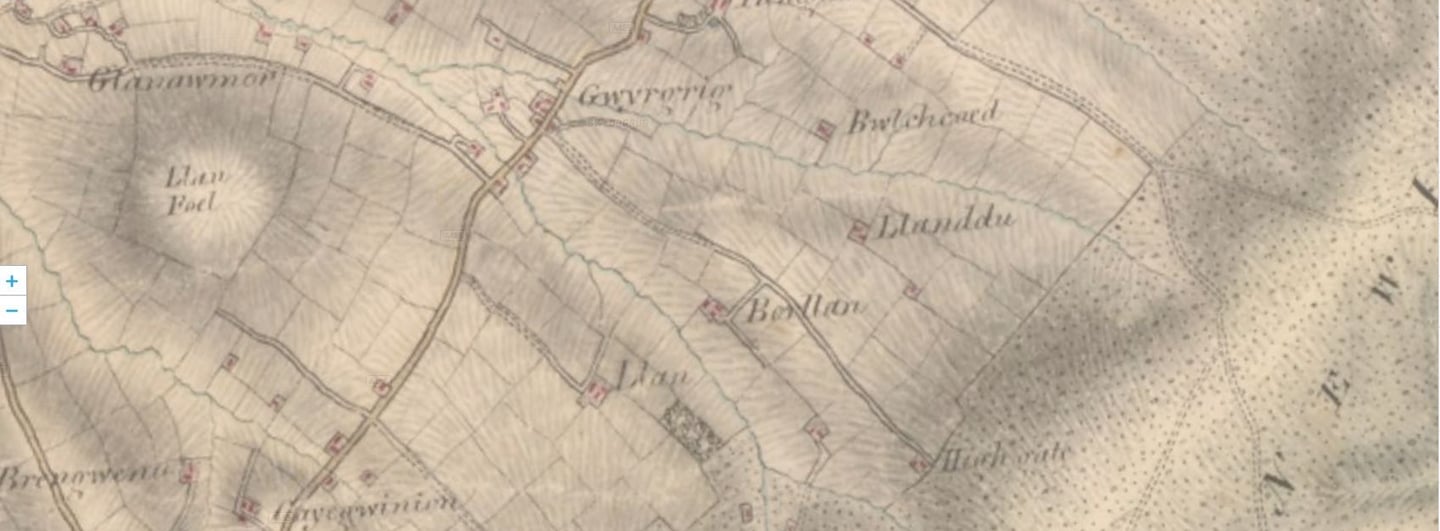
1811 map of Gwyddgrug showing Berllan farm
The history of Y Berllan
Y Berllan sits at the heart of this ancient landscape, its name meaning "The orchard" in Welsh. The farm is mentioned in 1580 when ‘Tyre y Berllan’ ("the orchard land"), is highlighted as one of 17 tenants taken to the Star Chamber (court) for non-payment of rents to the new leaseholder of the grange. Later recorded in 1633 as Tir y Berllan, the farm has shaped and has been shaped by the Gwyddgrug community for over four centuries.
The earliest known occupant in modern records was David Rees, who farmed here in 1805 and whose will that year passed the farm to his son John.
It is difficult to precisely date the house, but from the general style and features such as the window design and inglenook fireplace, it is thought to date from sometime between the 1750’s and early 1800’s. A Georgian penny, found in the house, was found on the property.
In 1823, John Evans, ‘Gent’ - likely the same John - died aged sixty-four and was interred at Llanfihangel ar Arth churchyard.
His son, another John Evans, is recorded at Berllan in 1837. By 1851 this John, now fifty-seven, farmed the 64-acre holding with his wife Mary (aged 48) and their two daughters, Mary and Hannah.
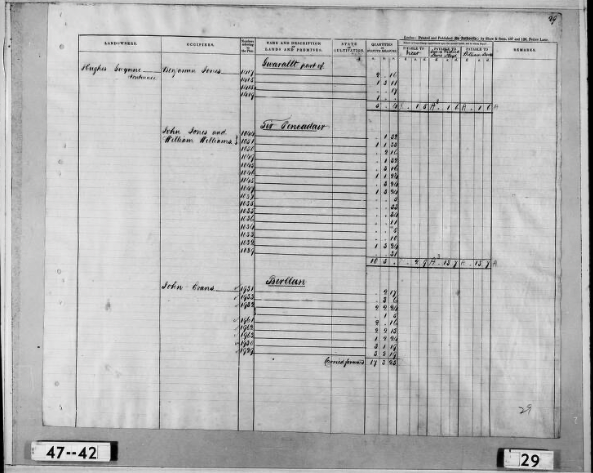
The tithe records of 1842 - with Berllan clearly marked on the accompanying map, its fields numbered and measured - formally confirm Gwynne Hughes as landowner and John Evans as tenant. The schedule lists Berllan's many parcels of land, painting a picture of a well-established working farm in the Carmarthenshire countryside. The Tithe rent charge (now paid in lieu of tithes) was £508 (15s, 5d Vicar; £2, 2s, 0d James Richard Lewis Lloyd; £2, 2s, 0d William Lewes. The named rent recipients (Lewis Lloyd and Lewes) were both wealthy landowners.
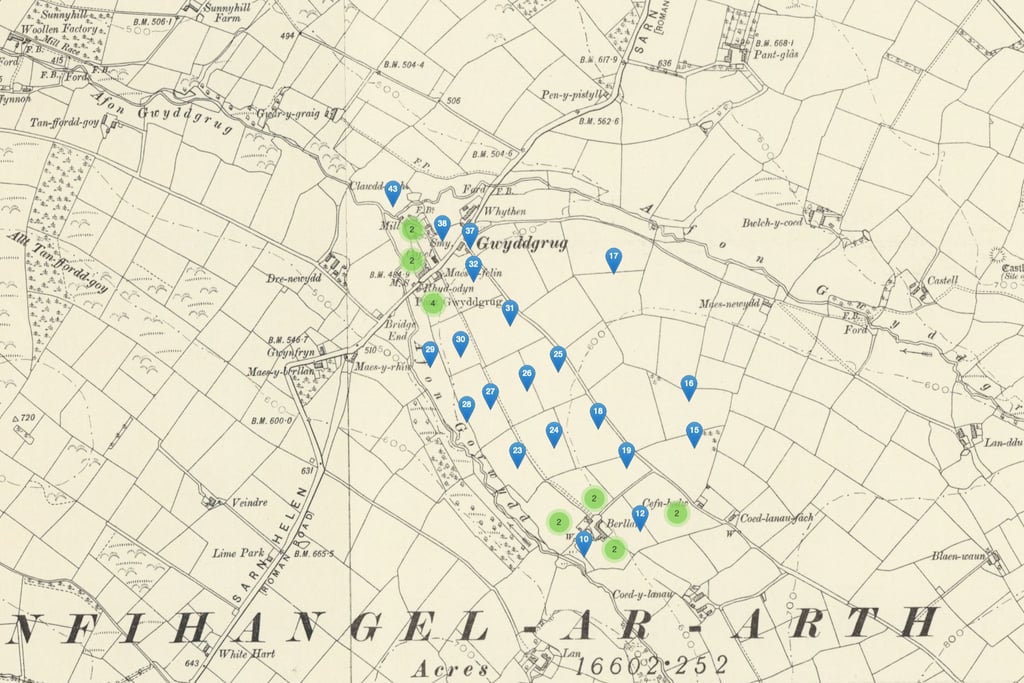
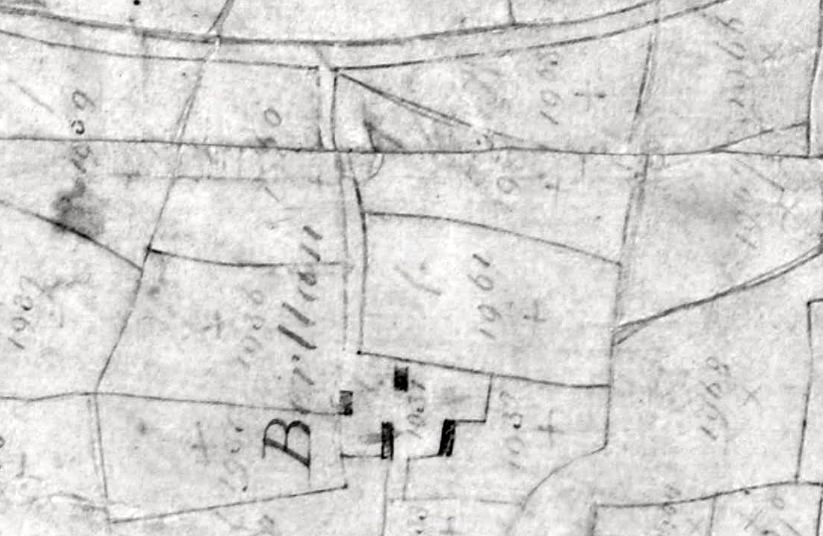
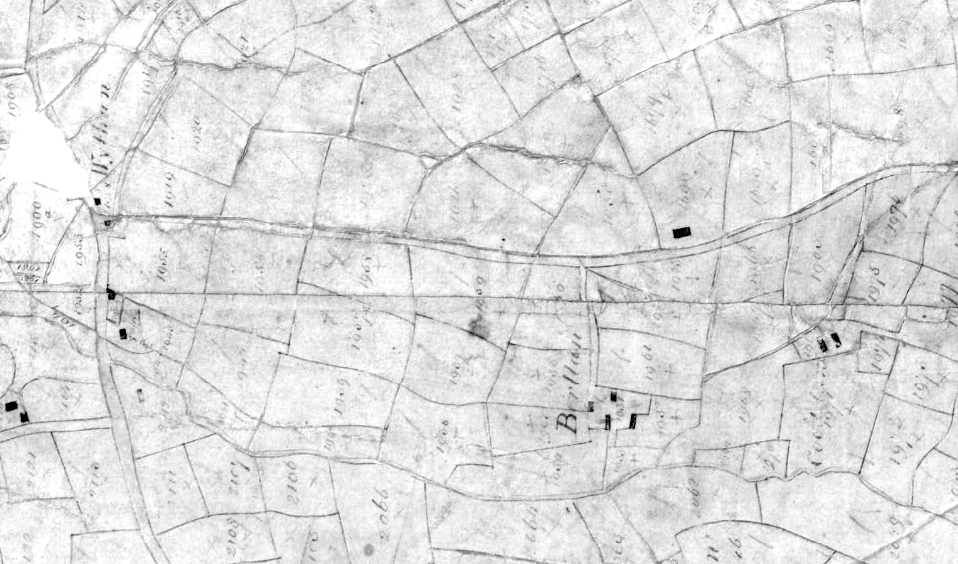
Extent of Berllan farm superimposed on 1842 Tithe map
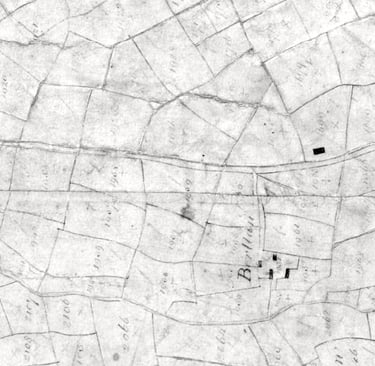
1842 tithe map of Gwyddgrug showing Berllan farm
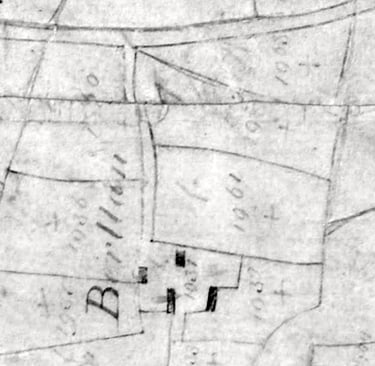
Detail of the 1842 tithe map showing Berllan farm house, outbuildings and adjacent field boundaries
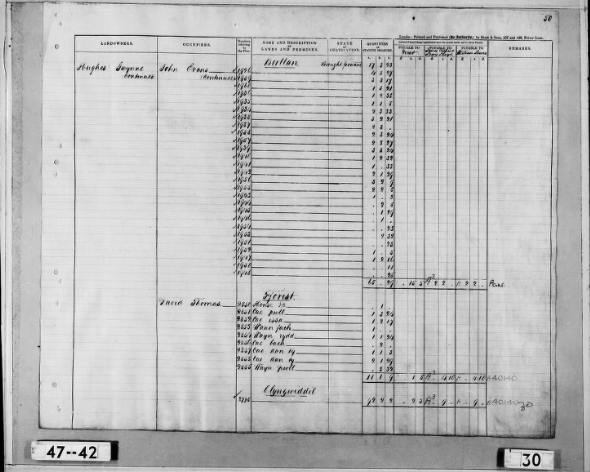
Tithe schedule page 2, 1842 - listing Berllan's field parcels and rent charge payable.
Tithe schedule page 1, 1842 - confirming John Evans as occupier of Berllan
On Evan's death in 1872 his widow Hannah continued to manage the property, though by the 1881 Census her son Thomas had become head of the household. Thomas married Rachel Phillips of Pantglas, Pencader, and the couple had two sons. Tragically, Thomas died in 1884, leaving his twenty-four-year-old widow to raise David (aged 9) and Evan (aged 8 - born 1883) alone. Sadder still, Rachel herself died on 6 April 1891, aged just thirty. At the time of her death, a five-verse poem in Welsh appeared in Y Celt, a weekly Welsh-language newspaper, praising her devotion to her faith, her family and her community. References within the poem suggest she may also have been a harpist - a beautiful detail connecting Y Berllan to Wales's rich musical heritage.
After Rachel's passing, her two sons managed the farm together. In 1905, Evan was fined one shilling for using an ‘unfenced chaff cutter’, and by 1911, aged twenty-eight, he is recorded at Y Berllan with two farm servants. His brother David had by then left for pastures new. Evan eventually followed, settling in Bittesby, Leicestershire where he tenanted the 539 acre Bittesby House Farm from 1933 to 1944 when the estate was sold. When he died in 1949, he returned to be buried at Gwyddgrug Chapel burial ground. The event was recorded in a handwritten note on the plaster in the barn.
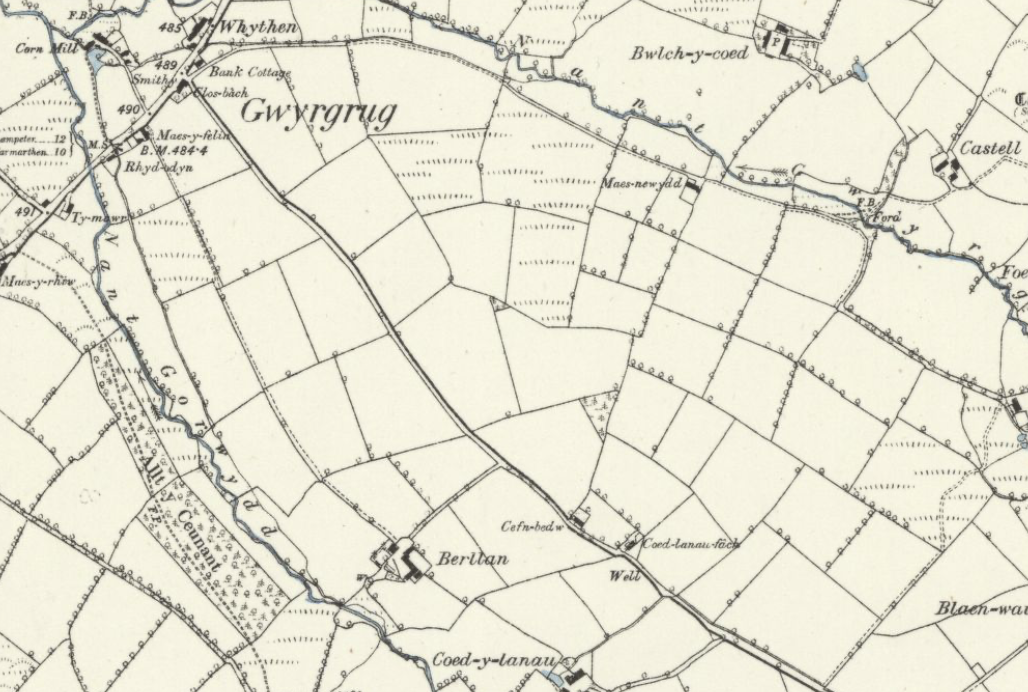
Ordnance Survey map, 1872 - showing Berllan in its landscape setting
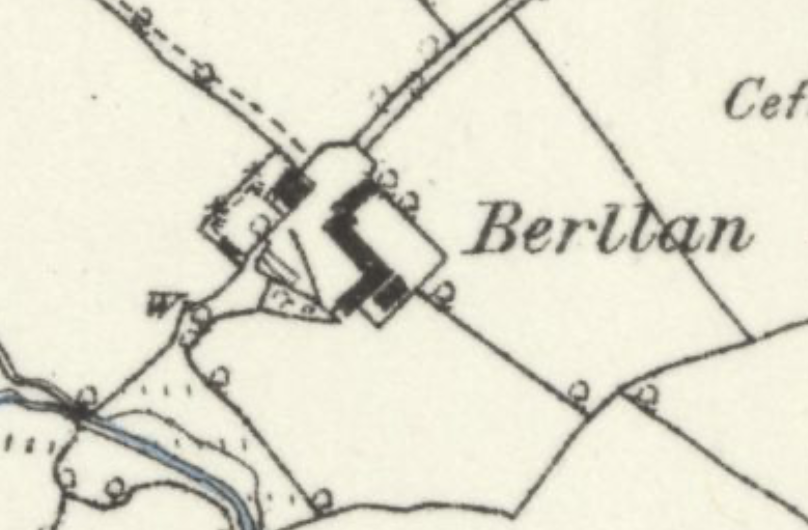
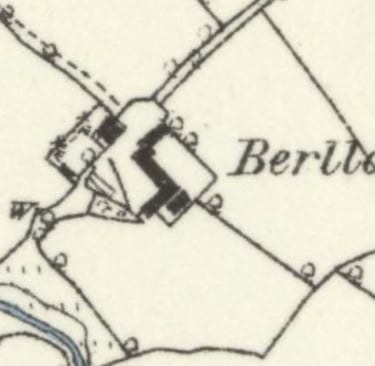
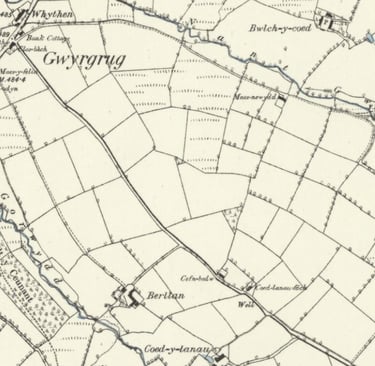
Ordnance Survey map close-up, 1872 - detail of Berllan farm. The L shaped barn, now converted to holiday cottages, is now clearly shown. The water supply (a spring) is shown marked ‘W’.
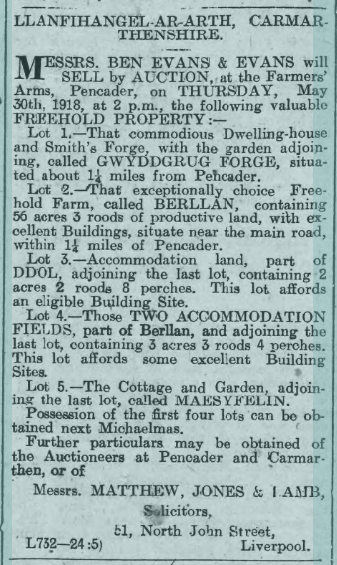
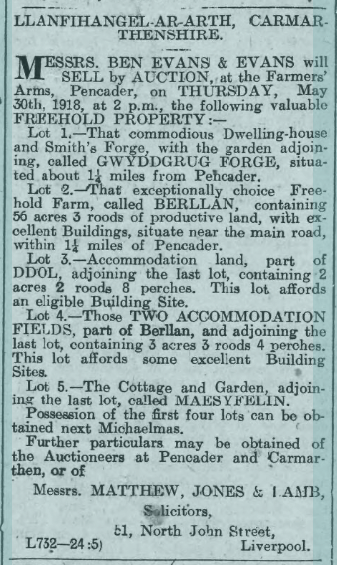
On 30 May 1918, Messrs Ben Evans & Evans offered ‘the exceptionally choice freehold Farm called Berllan’ for sale by auction at the Farmers' Arms, Pencader, in five lots. Lot 2 was described in the sale particulars as "that exceptionally choice Freehold Farm, called Berllan, containing 56 acres 3 roods of productive land, with excellent Buildings, situate near the main road, within 1½ miles of Pencader." The sale also included Gwyddgrug Forge with its Smith's Forge and dwelling (Lot 1), two parcels of accommodation fields belonging to Berllan (Lots 3 and 4), and the cottage Maesyfelin (Lot 5).
From the early 1920s or possibly from the date of the auction in 1918, the farm was home to Richard Howells, a dairy farmer (born 22 June 1886, died December 1946), and his wife Jane (née Jones, born 15 March 1892, died June 1953). They were survived by their daughter Annie Mary Howells (1924-1998) and son John Henry Howells (1927-2015), the latter fondly known throughout the area as John y Berllan.
2017
We purchased Berllan in 2017 and set about carefully restoring and renovating the historic farmhouse.
The farm proved to be a time capsule of life over the past 200 years. The house itself had been left untouched, with many of the Howells possessions still in place providing a fascinating insight into life in the rural community.
Upstairs, there were four bedrooms, downstairs there was a kitchen, hallway and parlour, with the rear afea (under the ‘cat slide’ roof) forming a washing area and an area for salting meat.
The house had no bathroom or toilet facilities and the only cooking facilities was an open fire and bread oven in the kitchen.
With no plumbed water in the house, all water came from a small spring further down the hill or from the river at the bottom of the hill.
There was also no electricity with the only light coming from candles or hurricane lights.
The house was furnished with a combination of Victorian and Edwardian furnishings including metal bedsteads with straw mattresses.
The items we found included the black out blinds from the second world war, John and Annie’s school books and accounts records detailing their personal and farm expenditure and small toys and puzzles. They had kept hundreds of magazines include ‘War time’ and ‘Titbits’ – from the 1960’s but also farm machinery catalogues including one from the 1910’s.
Household and kitchen items we found included a cast iron cauldron, cooking pots, flat irons and various fire paraphernalia. Annie apparently played the piano, the remains of which we found in the kitchen.
The barns provided facilities for the variety of farm activities. The upper part of the barn included various machinery for threshing and cutting fodder, all belt driven from a Lister engine on the ground floor. The lower level comprised cart shed, cow milking shed, stables and pigsties.
Underneath the collapsed debris of the barn and outside, were old farm equipment, from the 19th and 20th centuries. The majority of this was equipment powered by or related to horses – both farm equipment such as ploughs, harrows, saddles and other horse related items such as horse shoes.
We also found the remains of an old car and a Ferguson tractor (dating from the late 1940s) and related Freguson equipment (such as a finger mower) was spread around the surrounding land. Interestingly, by local accounts, John didn’t drive so we aren’t sure who used the tractor!
We’ve taken care to save what we can. Amongst the smaller items, we’ve found hand tools such as scythes, sickles, pitchforks and sheep shearing equipment.
2020-2023
Between 2020 and 2023 we converted the traditional stone barn into three beautiful self-catering holiday cottage, opening our doors to guests in 2024.
2024 onwards
The barn that appears on the 1872 OS map - the same barn where Evan Jones's family recorded his return burial in a handwritten note in 1949 - now welcomes holiday guests from near and far. Whether you're touring Wales, looking for a short break in the Carmarthenshire countryside, heading out to walk or cycle the trails of nearby Brechfa Forest, or visiting friends and family in the area, Berllan offers a peaceful rural retreat steeped in genuine Welsh history and heritage.
We hope you'll feel the warmth of the generations who lived and worked here - and that you'll leave, as so many have, a little in love with this hidden corner of West Wales.
Berllan is part of Cambrian Cottages
References
Dube, Steve - This Small Corner: A History of Pencader & District (2000)
Hughes, Carmarthenshire Antiquary
The Welshman; The Carmarthen Journal
Welsh Newspapers Online; Ancestry.co.uk; Findmypast.co.uk
D.G. Lloyd - Tir yr Abad: Hanes New Inn a Gwyddgrug yn Sir Gâr (1996)
Alan Richards - Great Walks in Carmarthenshire - 3




Cambrian CottageS
Berllan, Gwyddgrug, Pencader, Carmarthenshire, Wales SA39 9BL | stay@cambriancottages.com | 07786 626010
what3words ///songbirds.gilding.camped
© 2026 Cambrian Cottages
Cookies | Privacy | Policies | Terms and conditions | Travel trade | FAQ | Press